Monday, November 11, 2013

Maya God Profiles: The "Paddler Gods"

Back from a long break after completing my PhD thesis, I thought I would start things off by featuring a list over the next few months of several Maya God profiles and include some new readings and interpretations. A short commentary on each god will be given along with its “activity profile” that tries to ascertain the identity of the god and its particular duties. The commentaries are by no means a complete or final word on the nature of each god and are only meant to serve as referential descriptions. Their profiles will no doubt change and expand in the coming years with each new investigation as their activities are mapped across Maya myth, ritual and art. I am starting off with an enigmatic set of Gods nicked-named the “Paddler Gods”.
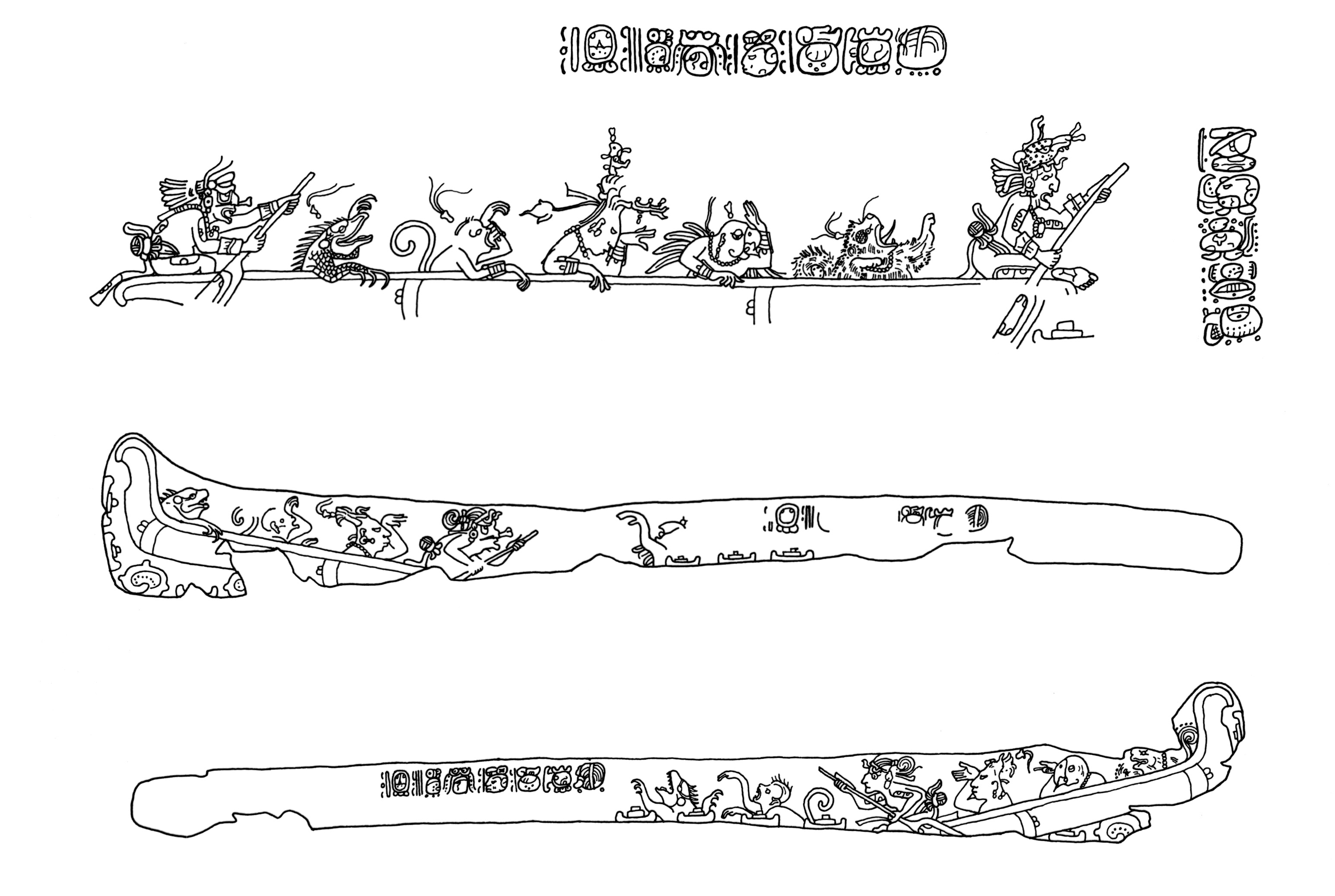
Tikal Bones from Burial 116
Drawings by Linda Schele Courtesy of FAMSI

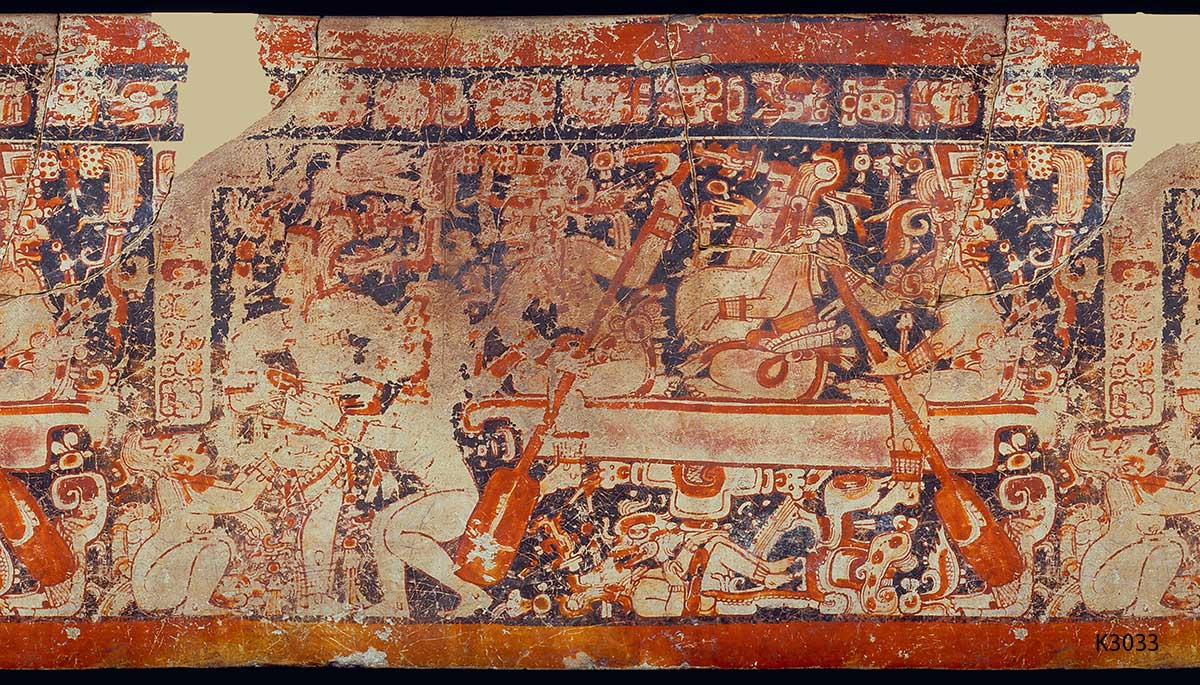
The “Paddler Gods” first identified by Mathews (2001:394) are paired deities seen often ferrying gods in a dugout canoe. The portrait heads of each aged god bear wrinkled jowls, jutting toothless jaws. The “Jaguar Paddler” displays the ear, canine and spots of a jaguar and the “Stingray Paddler” wears a pierced bone (stingray spine) through the septum of his nose (Mathews 2001:394). Variant logographs night (AK’AB) and day (K’IN) substitute for their respective names (Villela 1991) revealing their dualistic nature representing night and day. Their role as paddlers are best known from Tikal Burial 116 bones MT38a and MT38b that show them at the bow and stern of a boat transporting a deceased Maize god through the underworld waters (Stone and Zender 2011:51). Yet, they are also depicted on various ceramics as the boatmen who carry the Maize God to his place of rebirth (Quenon and Le Fort1997).

Kerr Vase 3033
 Photo by Justin Kerr Courtesy of  mayavase.com
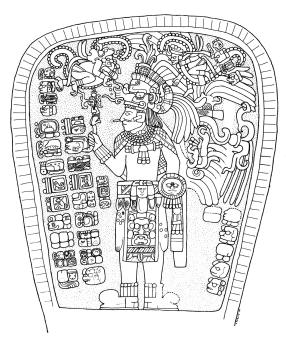
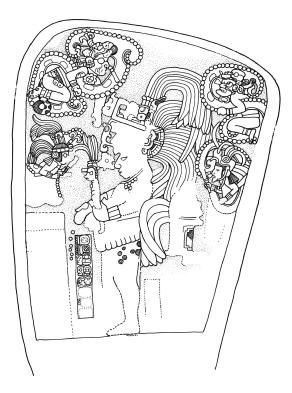
As Jimbal Stela 1 and Ixlu Stela 2 attest,  MUYAL cloud scrolls coil around these gods as they float above rulers performing various rites; Jimbal Stela 1 reinforces this cloud-rain association by adding to their appellatives the title of the rain god NAH JO’ CHAN CHAAK; in some cases the “Paddler Gods” might perform possible rites of “bathing” (AT) (Stuart et al. 1999).
Jimbal Stela 1
Drawing by Linda Schele Courtesy of FAMSI

Ixlu Stela 2
Drawing by Linda Schele Courtesy of FAMSI

The  Jaguar Paddler God from Ixlu Stela 2. Photo by Carl Callaway 2010.

The Stingray Paddler God from Ixlu Stela 2. Photo by Carl Callaway 2010.

Finally on Quirigua Zoomorph G, East side (N2) the “Paddler Gods” carry the MUYAL-li cloud logograph (a neat head variant of the sign) in their title reinforcing the cloud/mist connection.

Quirigua Zoomorph G Initial Text, Blocks A-P
 Drawing by Matthew Looper

On era day 13.0.0.0.0 4 Ajaw 8 Kumk'u, these gods are related to three actions: Quirigua Stela C records that they erect the first of three stones in a sacred locale named NAH JO’ CHAN “JAGUAR THRONE”; Piedras Negras Altar 1 associates them directly to the “changing of the altar/pedestal” event; while “Tila” Stela A relates the pair to a possible “bathing” event.


Works Cited

Mathews, Peter 

2001(1977) The Inscription on the Back of Stela 8, Dos Pilas, Guatemala. In: TheDecipherment of Maya Hieroglyphic Writing, edited by S. D. Houston, D. Stuart, and O. Chinchilla M., pp. 394-415. Norman, University of Oklahoma Press.

Quenon, Michel, and Genevieve Le Fort

1997 Rebirth And Resurrection In Maize God Iconography. In: The Maya Vase Book: Vol. 5, Justin Kerr and Barbara Kerr (eds.), pp. 884–902. New York: Kerr & Associates.

Stone, Andrea, and Mark Zender

2011 Reading Maya Art. London: Thames and Hudson Ltd.

Stuart, David, Stephen Houston, and John Robertson

1999 Recovering the Past: Classic Maya Language and Classic Maya Gods. In: Notebook for the XXIIIrd Maya Hieroglyphic Forum at Texas. Austin: Texas.

Villela, Khristaan D

1991 Early Notices on the Maya Paddler Gods. In: Texas Notes on Precolumbian Art, Writing, and Culture, 17, University of Texas at Austin. Austin : Center of the History and Art of Ancient American Culture.

Sunday, March 17, 2013

Rubbings of Ancient Maya Sculpture by Joan W. Patten is now available!

Cover Design By Paul Johnson


Hello Everyone,

My book Rubbings of Ancient Maya Sculpture by Joan W. Patten is now in print. The book Includes a short ten page biography along with a compilation of Maya Rubbings by the Late Joan W. Patten. While working for the Guatemalan Government in the '60's and '70's, she fashioned a large corpus of over 900 Maya Rubbings as well as replicas of ancient Maya sculpture:


American Sculptor Joan W. Patten (1924-2005) lived and traveled extensively throughout Guatemala from 1965-1982. The Guatemalan Government granted Joan official, carte blanche permission to make molds, casts and replicas of ancient Preclassic (1500 BC-250 AD) and Classic (250-900 AD) Maya relief sculpture. Her replicas of Maya stelae currently stand in Guatemala’s Museo Nacional de Arqueología y Etnología, the National Zoo and at the Museo Popol Vuh gardens at Francisco Marroquín University. In addition to the replicas, she executed hundreds of rubbings in oils on colored fabric. With a sculptor’s touch and infinite patience, she rendered images onto cloth that are remarkably sharp in detail and line. The rubbings include images that preserve an abundance of information about Maya sculptural traditions, iconography, hieroglyphic writing, mythology and history.


A selection of these rubbings can be viewed at the Mayaweb Art site under the 'rubbings' tab:


A preview of the book and book list is also available at:


I met Joan Patten toward the Autumn of her life in 1997 at a Bill Davies dinner party in San Luis Obispo, California. The connection was electric and we talked of all things Maya deep into the night. I later visited her apartment in San Francisco to assess her cast and rubbing collection that numbered over nine hundred images. I was stunned how well she captured the details of the glyphic writing that chronicled of the deeds of ancient gods and heroic kings. As I read the glyphic texts, she was equally impressed by how far Maya studies had advanced in breaking the Maya Code and reclaiming lost history. In the months that followed, I and my friends Jeff Buechler and Paul Johnson worked to document and preserve this unique record of Maya monumental sculpture. While attending the University of Texas in 2004, Joan called telling me she was diagnosed with cancer and we spoke of the beauty and brevity of life and how best to preserve her work for future study and scholarly access. Upon her passing, I received a letter from her son Keith Patten stating that Joan had asked that a portion of her rubbing collection be left to me along with her small library of Maya books. I was deeply touched and always knew I would return this gift with a publication on Joan’s work. 

If any of you know of any rubbings made by Joan send me an email so I can reference them and add them to the inventory.

Best,

Carl

Sunday, December 16, 2012

What Time of Day Does the Ancient Maya Calendar Commence?


A Hypothesis on the start times of the 260 day tzolk’in, the 365 day haab 
and the Long Count Calendars


At what point during the day did Ancient Maya scribes commence the calendar count, at sunrise, noon, sunset, or midnight? The question becomes even more tangled with the realization that to signify a day there is not just one calendar in play but three: the 260 day tzolk’in, the 365 day haab and the Long Count. Did all three calendars start at the same initial hour or did each have their own distinct starting point (e.g. dawn, noon, sunset or midnight)?
How Maya scribes refer to a Calendar Round holds clues as to the respective starting point for each of the three calendars. Clues to a Calendar Round’s inner workings are found in a spurious set of inscriptions which Proskouriakoff and Thompson (1947) named “Puuc-Style Dates” where the numerical coefficient for the recorded month (the haab) was out of synchronization with the tzolk’in coefficient by one day. These researchers also noted that “Puuc-Style” dating occurred widely during the Late Classic in northern Yucatan and occasionally in lowland areas as well. In general, they saw the “Puuc-Style” dating as a local variant of a non-conformist calendar system that differed with the lowland calendar system by one day (Stuart 2004). Mathews (2001) addressed the question of “Puuc-Style” dating in his examination of the Dos Pilas Stela 8 text. The inscription recorded a Calendar Round date with a month coefficient that was obviously off by one day. Mathews did not attribute the miscalculation to scribal error or to the aberrant “Puuc-Style” counting system. He proposed that the tzolk’in and the haab calendars began at different times during the day. This idea assumes that the tzolk’in commences earlier than the haab or the Long Count cycles (Mathews 2001:406). Specifically, Mathews states:
Moreover, it is possible that the tzolk’in day and the haab day began at different times in the 24 hour day; if so, we could expect a minority of the dates to not be in the “normal” form. In other words: if, for example, the tzolk’in day began at 6:00 P.M., and the haab day began at 6:00 A.M., and some event took place at midnight, then the tzolkin date would be advanced one position over the haab date. Thus.  .  .  the date 9.14.15.2.3  2 Akbal 1 Kankin would after 6 P.M., be 9.14.15.2.3  3 Kan 1 Kankin―as recorded at H13-I13-and not until 6.00 A.M. the following day would the next “normal” date begin, viz., 9.14.15.2.4  3 Kan 2 Kankin (Mathews 2001:406).
What Mathews posited was that the “Puuc-Style” dating was not an aberrant counting system, but rather the “error” of minus-one-day, revealed by the inner mechanics of a Calendar Round date. Mathews also noted that on nine examples of aberrant dates a “half-darkend k’in” sign preceded the errant date and posited that this glyph signals a nighttime event (Mathews 2001:406) [1]. In his final analysis he postulated a likely scenario for start times: the tzolk’in commenced at a prior sunset while the haab commenced at the following dawn.
David Stuart later championed Mathews’ insights with a paper titled The Entering of the Day: An Unusual date from Northern Campeche (Stuart 2004) where he examined the inscription carved on a door lintel from the Hecelchakan Museum reading  4 Muluk K’IN o-chi-ya tu-16 MAK. As Stuart noted:
The remarkable feature of the date record is the sign grouping o-chi-ya located between the day and the month glyphs. This can only be the verb ochiiy, ‘it entered’ . . . The mention of the day ‘entering’ within the haab suggests that we have been misled in thinking that northen Puuc-style dates simply reflect a localized structural change in the reckoning of time. Could it be that many of the ritual events commemorated in Puuc inscriptions—the vast majority of them are dedication rites—actually took place in the window of time between the turn of the haab and the arrival of the tzolkin—perhaps between midnight and dawn? . . . If these were nighttime rituals, scribes of the Puuc region may have been especially diligent in utilizing the subtle mechanisms of the Calendar Round to specify just when certain events took place within our own conception of a 24-hour day .  .  . (Stuart 2004:1-2).
Stuart continues to say that it is possible that the “Puuc-Style” dates are not a separate system after all but a calendar containing “nighttime indicators” recording night rituals. Yet, he differs with Mathews in theorizing the turning point between the two calendars and favors a separation by six hours rather than twelve, with the haab starting at midnight and the tzolk’in at dawn.
What is the proper turning point for each of the three respective calendars and how many hours they are out of sync from each another? The question will be resolved in two parts: (1) in a translation for “the half-darkened k’in” sign and (2) by looking at how a count of days (k’ins) is related to the haab and the Long Count. Recently, MacLeod and Schele (2005) jointly investigated and updated a catalogue of “Puuc-Style” dates within Maya inscriptions. They compiled additional evidence that the haab and the Long Count do indeed begin at sunrise and that it is the tzolk’in that is out of step by twelve hours. The first line of evidence concerns a reading for the “half darkened k’in” sign that often accompanies aberrant dates, as previously noted by Mathews. MacLeod (p.c. 2008) noted she proposed a reading in 1991 for this “half-darkend k’in” sign; the collocation is sometimes spelled yi-K’IN-ni and suggested the readings of chah-k’in or yi’h-k’in (for the variant with T135 /cha/ superfixed “darkened sun” and “aged sun” [2]. A darkened, aged, or black sun lends itself to the idea of “sunset” rather than just “night” and MacLeod posited that this glyph reflects a sunset position (MacLeod and Schele 2005)[3]. Additionally the logograph PAS for “dawn” is further evidence that Maya scribes recognized the horizon position of a dawning sun (p.c. MacLeod 2010). In her analysis and comparison of the errant dates on Dos Pilas Stela 8 and Yaxchilan Stela 18, MacLeod (p.c. 2005) saw a similar error pattern emerging. She noted:
[The Yaxchilan date of] 3 Eb given on the monument represents a tzolk’in that has advanced by one, ahead of the haab, just as 3 K’an at Dos Pilas represents a move forward by one in the tzolk’in. These two dates represent the same pattern. Both of these have moved ahead not only of the haab but also of the Long Count. I really think this is the key. The Long Count counts days―that’s what the ‘ones’ unit is  .  .  .  k’ins! .  .  . The monuments record not only a shift forward in the tzolk’in but also a half-darkened k’in sign―further evidence that the out-of-whack Calendar Round refers to a night event which immediately follows the correct Type III [normal] date in each case  .  .  . It is the tzolk’in which is out of step. Furthermore, it just makes good conceptual sense that a system that counts days as the Long Count should start those days when the day begins― at sunrise. Therefore, the only way the tzolk’in can get out of step is to change at sunset. I truly believe that this plus the specific mention of the half-darkened k’in (a perfect image of sunset) in these two critical cases is all the proof we need (p.c. MacLeod 2005).
For the sake of building an event-line horizon and plotting the starting points of all three calendars, the current study agrees with a combined Mathews and MacLeod/Schele hypothesis that: (1) the haab is in-step with the Long Count, (2) the tzolk’in is out-of-step with the haab by 12 hours, and (3) the tzolk’in begins at sunset 12 hours prior to haab at dawn.
This combined hypothesis now allows the proposal of a timeline corresponding to the solar trek. First, the two parts of the Calendar Round, the tzolk’in and the haab have separate starting points with the haab commencing at dawn and the tzolk’in starting at sunset 12 hours earlier. The Long Count (a count of suns) is synchronized with the haab solar calendar and therefore begins at dawn as well. A charted time-line (with a twelve hour shift between the tzolk’in and the haab) for the base date 4 Ajaw 8 Kumk’u is as follows:

4 AJAW ― DUSK (tzolk’in cycle starts) [+ 12 hours] DAWN (haab day and Long Count cycle start) [+12 hours] DUSK (tzolk’in cycle completes) [+ 12 hours] DAWN (haab day and Long Count day cycle complete the first day) —  8 KUMK’U

Only when the tzolk’in and haab have both completed their respective 24 hour cycles (totaling a span of 36 hours due to the 12 hour shift between both calendars) can the day be recorded as a complete elapsed day 4 Ajaw 8 Kumk’u. If the day records an action after the tzolk’in has finished its 24 hour cycle but prior to the haab completion, then the day and month coefficients of the Calendar Round are recorded out-of-sync by one day and therefore record a tzolk’in coefficient advanced by one day ahead of the haab date [4].


More grist for the mill.

Carl


[1] See Yaxchilan Stela 18 (A1-A3) for just such a date.

[2] A reading of yi-K’IN-ni as “black of the day” has also been recently proposed (Houston, Stuart and Chinchilla 2001:395).
[3] the yi-K’IN-ni sign also interchanges with glyph G9 of the Lords of the Night)
[4]A calendar with embedded with “nighttime indicators” (Stuart 2004) indicating current time within a 36 hour time span is disturbing to say the least. Past researchers have agreed in principle that the Maya never designated a present day or as an unfinished unit, but always treated the day as elapsed time; as Morley noted “the day recorded is yesterday because to-day can not be considered an entity until, like an hour of astronomical time, it completes itself and becomes a unit, that is yesterday” (Morely 1975:470). The Puuc dates are heretical indeed!

Works Cited 


Houston, Stephen  D. Stuart, and O. Chinchilla M. (eds.)

2011 The Decipherment of Maya Hieroglyphic Writing. Norman, University of Oklahoma Press.

MacLeod, Barbara and Elaine Schele
2005 The Puuc Heresy. Paper written for a seminar on Maya Hieroglyphic Writing, Department of Art History, University of Texas at Austin. Paper in possession of the authors.


Mathews, Peter
2001(1977) The Inscription on the Back of Stela 8, Dos Pilas, Guatemala. In:
TheDecipherment of Maya Hieroglyphic Writing, edited by S. D. Houston, D. Stuart, and 
O.Chinchilla M., pp. 394-415. Norman,University of Oklahoma Press.

Morley, Sylvanus Griswold
1975 An Introduction To The Study Of The Maya Hieroglyphs. New York: Dover
Publications.


Proskouriakoff, Tatiana, and J. Eric S. Thompson
1947 Maya Calendar Round Dates Such as 9 Ahau 17 Mol. In: Notes on Middle American Archaeology and Ethnology, no. 79. Carnegie Institution of Washington, Division of Historical Research, Washington, D.C.


Stuart, David
2004  The Entering of the Day: An Unusual Date from Northern
Campeche. On-line at Mesoweb:www.mesoweb.com/stuart/notes/EnteringDay.pdf.

Sunday, October 7, 2012

Carl Callaway's PhD Thesis: A Catalogue Of Maya Era Day Inscriptions

South Face of Quirigua Zoomorph P that contains an era day inscription
Well its official, I received notice from La Trobe University that my PhD was granted so I can finally share a copy of my dissertation on Maya era day inscriptions. I hope it is as rewarding for you to read as it was for me to research and write. All the source data for all known era day events (the verbs, the gods, the locations) is listed in the appendices for easy reference.  Here is the abstract :

The following work is a catalogue of all known era day inscriptions existing in the Maya hieroglyphic corpus originating from Classic Period Maya (250-900 AD) sites in Mexico, Guatemala, and Honduras. It compiles those mythic texts that occurred within a single day— the inaugural date of the Maya Long Count and the establishment of a new cosmic era on 13.0.0.0.0 4 Ajaw 8 Kumk'u (August 11, 3114 BC). Although past reviews  of era day mythology have greatly expanded our knowledge of Maya mythic history, they do not give a complete inventory of all known passages. This project offers a full inventory of these sacred texts and scrupulously analyzes each component including the various era day events, gods and mythic locales. In addition, the work examines Maya myth from an emic perspective by evaluating the different genres of mythology found within Maya literature with the purpose of clarifying how myth acted as a living force within society. It includes a transliteration, transcription and translation of each passage followed by a commentary that explores each text’s mythic, historic, architectural and religious associations. Once compiled, the work attempts to organize these passages within a hypothetical narrative and produce a tentative reconstruction of the basic era day story. At the very least, this study seeks to provide an organized body of data for future researchers interested in the topic of Maya cosmology.


I've uploaded a copy of the thesis ontoGoogle Docs at (send me an email and I can give you access): 


Looking back on the project, I now understand the James Joyce quote: "Anything deeply considered is a pathway to the gods". The dissertation is but a small glimpse into the imago mundi of ancient Maya cosmology and how myth gave birth to the Maya universe.

All the Best in 2012,

Carl

Tuesday, July 31, 2012

ARCHAEOASTRONOMY Volume XXIV: The Maya Calendar & 2012 Phenomenon Studies


ARCHAEOASTRONOMY Volume XXIV: is now available. The issue includes the following papers on the topic of 2012 studies:

The Maya Calendar and 2012 Phenomenon Studies: An Introduction
John B. Carlson

The Maya Long Count Calendar: An Introduction
Mark Van stone

It’s Not the End of the World: What the Ancient Maya Tell Us about 2012
Mark Van stone

Primordial Time and Future Time: Maya Era Day Mythology in the Context of the
Tortuguero 2012 Prophecy
Carl D. Callaway

The Sidereal Year and the Celestial Caiman: Measuring Deep Time in Maya Inscriptions
Michael J. Grofe

Maya Mythology: Only One Reference to 2012?
Erik Boot

Holding the Balance: The Role of a Warrior King in the Reciprocity between War and
Lineage Abundance on Tortuguero Monument 6
BarBara MacLeod

Anticipating the Maya Apocalypse: What Might the Ancient Day Keepers Have
Envisioned for December 21, 2012?
John B. Carlson

New Age Sympathies and Scholarly Complicities: The History and Promotion of the
2012 Mythology
John w. Hoopes

2,012 by 2012? The “Impending Apparent End” of the “2012” Publishing Phenomenon
Kevin a. Whitesides

The issue is now being printed and bound by University of Texas Press Journals and will be mailed out to subscribers around the middle of August. 

Here is the URL from the UT Press;
http://www.utexas.edu/utpress/journals/jarch.html#XXIV

Friday, July 27, 2012

New 2012 Inscription Found at La Corona Guatemala

Among the many new exciting finds at La Corona was a hieroglyphic stairway containing several beautifully carved panels, one of which records another 2012 passage! For a preliminary report on the text, see David Stuart's Blog Post at: http://decipherment.wordpress.com/2012/06/30/notes-on-a-new-text-from-la-corona/ 

Wednesday, May 30, 2012

Analysis of the Term K’ojob in Era Day Expressions


The jehlaj k'ojob expression is the most widely quoted of all era day events in Maya inscriptions and it refers to the changing of a pedestal or altar at the start of the current era on 13.0.0.0.0             4 Ajaw  8 Kumk'u or August 11/13 3114 BC, the "zero" date of the Maya Long Count calendar. Here is an example from from Stela C, East side (block B6) of Quirigua, Guatemala:

JEL-[la]ja k’o-ba collocation from Quirigua Stela C
(Drawing by Annie Hunter) 

The item that is being changed is the k'ojob. The term is not well understood since it occurs very rarely in the inscriptions.  I thought a further inquiry into this enigmatic term might shed some light on the subject since so much of how we interpret this climatic era day event depends on knowing the type of the object that is being changed. The term k’ojob is found on the following era day monuments[1]:

Coba Stela 1, back (N18)
Chichen Itza, The Caracol (Structure 3C15), Panel 1, Right Lateral Face (R9)
Copan Stela 23, sides “A” (D7-D9) and “C” (F1)
La Corona Altar 4 (A’1)
Palenque, Temple of the Cross, Main Panel (D6)
Palenque, Temple of the Sun, Main Panel (E1)
Piedras Negras, Altar 1, Fragment B (L2)
Quirigua Stela C, East side (B6)

In all these cases, the word is spelled using two syllabic signs /k’o-/ and /-b’a/, with the intial /k’o-/ syllable spelled using the T220 sign that is a depiction of a clinched, downward pointing fist (Thompson 1962:449; Boot 2008:9). The /k’o/ syllable was first deciphered by Linda Schele based on a k’o-jo or k’oj for “mask” spelling on a Site R, Lintel 2 text associated with a figure wearing a mask (Schele 1991:108). Early in the decipherment of era day texts, it was proposed that the term k’ob might read yeb for “his stair” (Macleod 1991) with the T220 holding a syllabic value of /ye-/ (the T220 sign is very similar to the T710 /ye-/ sign representing the profile of a partially open right hand). As the meaning syllabic signs progressed, it became clear that T220 and T710 held distinct values of /k’o/ and /ye/ respectively. Schele used the /k’o/ value for T220 to derive k’oh, the word for “image/mask” on the Palenque Cross Tablet (D6) (while discounting the very prominent /–b’a/ syllable sitting directly under the /k’o-/ ) as well as on the K6593 Panel (block A4) (Schele 1992:122-123 and 127; Freidel et al. 1993:65-67 and page 70-71). Schele also applied the /k’o-/ value to a translation in the Quirigua Stela C era day text (B6) and arrived at a slightly different spelling than that on the Palenque Temple of the Cross example (this time incorporating the /-b’a/ syllable into the word) with a reading of k’ohba for “image or statue” (Schele 1992:123; Freidel et al. 1993:67). More recently, Freidel and MacLeod (2000) proposed a new reading for the subject of the era day expression at Palenque and Quirigua:
First of all, reevaluation of the Creation text at Quirigua C shows that the k’ohba “images(s)” reading was probably not correct. The subject of the “crossed planks” verb in Kan-Balam’s Palenque Creation texts, and in others, must be k’oob “hearth”, “trivit”, found in Yucatec k’ooben “hearth, hearthstones, kitchen with cognates in Kekchi “k’ub”; Chorti and Cholti “chub”- probably glottalized: ch’ub
The term was now thought to represent “hearthstone” and it relates to the colonial Yucatec Maya word for  k’ob’en “kitchen, hearth” that is composed of three stones on which a cooking griddle sits (cf. Barrera Vásquez 1980:406, after Boot 2009:9). This new reading has had favor among leading epigraphers in the field yet, others employ a more generalized term of “tripod” rather than hearthstone (Looper 2003:226).
The term k’ob is used in the inscriptions outside the context of era day expressions and these additional uses offer evidence toward its spelling and insights into its meaning (p.c. Péter Bíró 2008). Additional spellings of the word occur on Copan Structure 30, Altar 19469 (A1) (Schele 1990; Andrews 2005 et al. 2005:285-287) and Yaxchilan Hieroglyphic Stairway 5, Step 16 (block 81) (Boot 2009:111). The Copan altar is circular in shape and flat-topped; it is 30 cm in diameter and 8 cm thick and has wheel-like shape. A glyphic text is carved on its perimeter edge; the text “states that u yak’ chaak was brought out or manifested at the celebration of Yax Pasaj’s first k’atun of rule, and the ceramic effigy referred to is the yitah yahawil  “the companion of the lord or his office” (Andrews et al. 2005:287). This small circular altar makes an ideal platform on which the effigy indicated most probably sat. Notice how scribes spell the k’ob term on this Copan altar and on the Yaxchilan steps by adding the interior syllable /-jo-/ :

Copan Str.30 Altar 19469 (A1-A6):u-JEL k’o-jo-ba u ya-k’u CHAAK-ki .  . .


Yaxchilan Stairway 5 Step 16 (block 81):  .  .  .  k’o-jo-ba-li ye-TE’-je u-chan ta-ja-mo’-o? aj-15-ba-ki k’uhul-“YAX EG?”-[AJAW] KALOM-TE’

These two cases spell the term with the interior /-jo-/ syllable indicating that the word may be under-spelled in other cases when written as k’o-ba. The Copan example is especially telling since it occurs in phrase that uses the same verb jel collocation as in the era day expression by recording “the next k’ojob (of) uyak’u chaak”[2] The item possessed by uyak’u chaak is the k’ojob or the round flat-topped altar itself on which the inscription is written. Here is a photo of a cast of the Copan altar:


Copan Structure 30, Altar 19469
(Photo by Carl Callaway)

Here is close up of the main event. Note the addition of the /-jo/ syllable above the /-ba/ sign:


u-JEL k’o-jo-ba collocation on Copan Structure 30, Altar 19469
(photo by Carl Callaway)


 In the Yaxchilan example,  k’o-jo-ba-li ye-TE’-je u-chan ta-ja-mo’-o? aj-15-ba-ki k’uhul-“YAX EG?”-[AJAW] KALOM-TE’ the possessor of the k’ojobil is the king Itzamnaj Balam III the “guardian” and captor of Torch Macaw[3]. So, the question arises:  What is the meaning of k’ojob? Does the term name a particular flat-topped stone or a hearth stone? The full spelling of the term as k’o-jo-ba argues against the previous derivation as k’o-ba and a classification as a hearthstone.  
One more example of the term k’ob comes from the site of Joyanca  where it is part of a standard dedicatory phrase for another small circular altar (very similar in shape and size to the previous Copan altar) from Structure 6E-12 thought to be used as an incensario stand (Formé 2006:06). David Stuart transcribed the glyph blocks A2-C1 as: T’AB'AY u-k’o-b’a TUN-ni-li? (Formé 2006:06) Like on the Copan altar, the item indicated by the k’o-ba spelling is the circular altar that is being dedicated. The Joyanca stone, with its flat top is ideal for an effigy stand. It is difficult to ascertain given the present evidence, if the k’ojob refers to the altar/pedestal stone itself, or to the effigy/god it supports, or the altar/pedestal stone and the effigy/god together (p.c.  Barbara Macleod 2011). Based on the current evidence stated, the proper spelling of the term is k’o-jo-ba for k’ojob and may translate as a flat-topped, circular stone altar.
In a counter opinion David Stuart (2011a:216-219) interprets the term under consideration as not k’ojob but k’oj meaning “image,” “mask” or “face” with the /–ba/ suffix attached at the end of k’oj  root serving apparently as an instrumental suffix[4]. The new glyphic phrase reads something like jelaj k’oj baah for “the face-image changed” (Stuart 2011a:219)[5] with k’oj being in this case “image.” Stuart offers the following explination:
Perhaps the word k’oj refers to masks, images, or faces that should be equated in some manner with the three sacred stones dedicated on that day by the gods. I suggest this as a possibility because we’ve long known that the three stone heads or masks along a celestial band comprise an important cosmological symbol for the Classic Maya, most often manifested as small portrait heads attached to “sky belts” worn by Maya kings as part of the ceremonial costume for period-ending rituals. The “change of masks” might then, refer to the idea of the cosmos getting a new identity of some type― a makeover of sorts―which in turn became symbolically reflected in the ritual dress of Maya Kings, and especially in their cosmic belts (Stuart 2011a:12).
The new Stuart hypothesis is difficult to adopt in the face of such a strong correspondence between the object named in the dedicatory passage on the altars/pedestal stones from Joyanca and Copan.

Hopefully in the future, additional texts using the k’ojob term will come to light and help clarify its essential meaning and semantic domain.


[1] See Quirgua Stela F, west side, block B16 and Quirgua Zoomorph P, South text, blocks M3a-M2a for other JEL k’o-b’a expressions on non-related era day monuments.

[2] The presence of the /u-/ prefix attached to the term jel derives a type of “change” similar to the word “next” where the subject is coming immediately after a previous change (p.c. Barbara MacLeod 2012).

[3] The mention of the k’ojobil on Yaxchilan Hieroglyphic stair, block 81 is in conjunction with a possible capture event (block 72) on the day 9.18.6.5.11  7 Chuen 19 K’ayab  (blocks 70-71) and a date that is also shared on Yaxchilan Stela 5 (p.c. Peter Mathews 2012).

[4] Normally, Ch’olan languages attach an instrumental suffix to an intransitivized verbal root in order to derive a noun that indicates the instrument used to perform or achieve the action indicated by the verb (p.c. Sven Gronemeyer 2011). Schumann Gálvez gives the following definition in his 1997 Mopán grammar: “.  .  . se coloca después de una raíz verbal para señalar instrumento que se usa o sirve para ejecutar aquello que la raíz verbal indica” (Schumann Gálvez 1997:82). As to how an instrumental suffix applies the root of a noun like k’oj is difficult at present to ascertain, but Yucatec for example also allows a derivation from a nominal base.

 [5] Interestingly Stuart’s reading of k’oj as “image” reflects back to a similar era day reading made by Linda Schele concerning the Kerr 6593 Panel. As Schele (1992:123) states, the key word “in the era expression is k’oh, k’ohba or kohob, all meaning ‘image’ or statue. Also she thought that “Ilahi yax k’oh” translated as “was seen, the image or statue”, and that “hal kohba” meant “appeared the image or statue” (Schele 1992:123; Freidel et al. 1993:65-66). Schele believed that the “image” referred to was a great earth turtle from whose cracked carapace the Maize God emerges (see K1892). Stuart (2011b) recently nullified Schele’s interpretation on K6593 Panel on the grounds of a faulty verb derivation and a misidentification of a historical ruler named yax k’oj ahk chak k’u-? Ajaw (Stuart 2011b). However he does not challenge Schele’s original assertion that the k’oj term spelled on Kerr Panel 6593 simply k’o-jo without the /–ba/ suffix.

Works Cited

Andrews, E. Wyllys, and Cassandra R. Bill

2005    A Late Classic Royal Residence at Copán. In: Copán The History of an Ancient Maya Kingdom. E. Wyllys Andrews and William L. Fash editors. School of American Research Advanced Seminar Series, Oxford.

Barrera Vásquez, Alfredo
            1980    Diccionario Maya Cordemex. Mexico: Ediciones Cordemex.


Boot, Erik
2002  A  Preliminary Classic Maya-English/English-Classic Maya Vocabulary Of Hieroglyphic Readings. .http://www.mesoweb.com/resources/vocabulary/Vocabulary.pdf.

2008 The Hand in Classic Maya Hieroglyphic Writing. Mesoweb. Available


2009a The Updated Preliminary Classic Maya – English, English – Classic Maya Vocabulary of Hieroglyphic Readings. On-line at: http://www.mesoweb.com/resources/vocabulary/Vocabulary.pdf.


Formé, Mélanie
2006    La cronologia ceramica de La Joyanca, Noroeste del Petén, Guatemala. BAR International Series 1572, Archeopress, Oxford, England.


Freidel, David, and Barbara MacLeod
2000    Creation Redux: New Thoughts on Maya cosmology from Epigraphy, Iconography, and Archaeology. In: The PARI Journal, A quarterly publication of the Pre-Columbian Art Research Institute, Vol. 1, No. 2, Fall 2000, Valerie Greene (ed.).


Freidel, David, Linda Schele, and Joy Parker
1993    Maya Cosmos: Three Thousand Years on the Shaman's Path. New York: Quill William Morrow.


Looper, Matthew G.
2003Lightning Warrior: Maya Art and Kingship at Quirigua. Austin: University of Texas     Press.


MacLeod, Barbara
1991    Maya Genesis: The First Steps. North Austin Hieroglyphic Hunch No. 5. Austin.


Schele, Linda
1990    Preliminary Commentary on the New Altar from Structure 30. Copán note 72. Copán, Honduras: Copán Acropolis Archaeology Project and the Instituto Hondureño de Antropología e Historia.
1991     Notebook for the XVth Maya Hieroglyphic Workshop at Texas. Austin, TX: Department of Art and Art History, University ofTexas.
1992    Workbook For The XVIth Maya Hieroglyphic Workshop At Texas. Austin, Texas: University Of Texas At Austin.


Schumann Gálvez, Otto

                1997    Introducción al Maya Mopan.Universidad Nacional Autónoma de México. 290   p., Mexico.


Stuart, David
2011a The Order of Days: The Maya World And The Truth About 2012. New York: Harmony Books.
Stuart, David
2011b  Reinterpreting a “Creation” Text from Chancala, Mexico. Maya Decipherment Web Blog, on the web at: http://decipherment.wordpress.com/page/2/.


Thompson, J. Eric S.

1962    A Catalog Of Maya Hieroglyphs. Oklahoma: University Of Oklahoma Press.